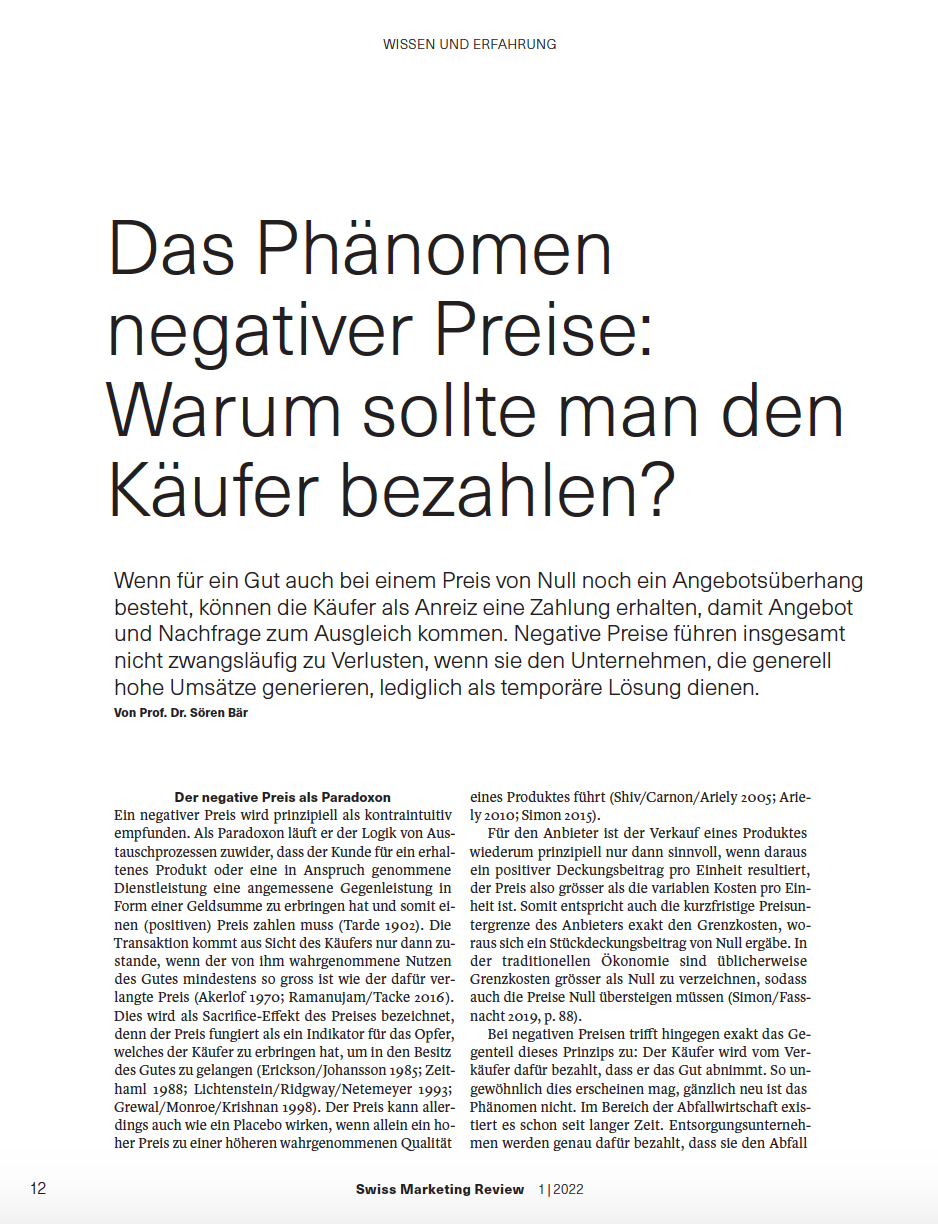

Die Ausgabe 1/2022 der „SWISS MARKETING REVIEW/MARKETING REVIEW ST.GALLEN“ widmet sich dem Thema „Pricing – Capturing Value“.
Prof. Dr. Sören Bär ist mit dem Paper „Das Phänomen negativer Preise: Warum sollte man den Käufer bezahlen?“ auf den Seiten 12-21 der renommierten Marketingzeitschrift vertreten.
Negative Preise laufen der Gesetzmäßigkeit und Logik von Austauschprozessen zuwider, dass man für ein erhaltenes Gut eine angemessene Gegenleistung erbringen muss, was üblicherweise in Form der Zahlung einer Geldsumme geschieht. Es kommt überhaupt erst dann zu einer Transaktion, wenn aus Sicht des Käufers der wahrgenommene Nutzen des Gutes mindestens so groß ist wie der dafür verlangte (positive) Preis. Auch für Anbieter ist der Verkauf eines Produktes prinzipiell nur dann sinnvoll, wenn daraus ein positiver Deckungsbeitrag pro Einheit resultiert, der Preis also die variablen Kosten pro Einheit übersteigt. In der traditionellen Ökonomie sind Grenzkosten größer als Null typisch, so dass auch die Preise von Gütern Null übersteigen müssen. Bei negativen Preisen kommt hingegen paradoxerweise exakt das Gegenteil dieses Prinzips zur Anwendung: Der Verkäufer erhält nicht nur kein Geld vom Käufer als Gegenleistung für die Überlassung des Gutes, sondern bezahlt ihn vielmehr sogar dafür, dass er es ihm abnimmt. Was zunächst kontraintuitiv erscheint, lässt sich dadurch erklären, dass bei einem großen Angebotsüberhang kein positiver Preis und selbst ein Preis von Null nicht ausreichen, um das Überangebot zu reduzieren. Die Käufer erhalten als Anreiz für die Abnahme einer nicht benötigten Menge eines Gutes eine Zahlung, damit Angebot und Nachfrage zum Ausgleich kommen können. Gänzlich neu sind negative Preise allerdings nicht. Auf einigen zweiseitigen Märkten haben sie sich seit längerer Zeit etabliert. Aufgrund der während der Corona-Krise entstandenen Überkapazitäten und des notwendigen Abbaus der damit einhergehenden Angebotsüberhänge sind negative Preise nunmehr viel häufiger anzutreffen. Die bei digitalen Gütern möglichen Grenzkosten von nahezu Null und intensive Preiskämpfe in vielen Branchen lassen eine höhere Frequenz des Einsatzes erwarten. Ebenso sehen sich Banken durch die Negativzinspolitik der Europäischen Zentralbank veranlasst, negative Zinssätze an die Verbraucher weiterzugeben. Negative Preise werden temporär sogar als Promotion-Instrument bei der Einführung neuer Produkte und als Anreiz im Rahmen der Neukundenakquisition eingesetzt, um das psychologische Motiv der Verknappung zu nutzen.

The 1/2022 issue of „SWISS MARKETING REVIEW/MARKETING REVIEW ST.GALLEN“ is dedicated to the topic „Pricing – Capturing Value“.
Prof. Dr. Sören Bär is represented on pages 12-21 of the well-known marketing journal with his paper “The phenomenon of negative prices: why should you pay the buyer?”.
Negative prices run counter to the legality and logic of exchange processes, that an appropriate consideration must be given for a good received, which usually takes the form of a payment of a sum of money. A transaction only occurs when, from the buyer’s point of view, the perceived benefit of the good is at least as great as the (positive) price demanded for it. In principle, the sale of a product only makes sense for suppliers if it results in a positive contribution margin per unit, i.e. the price exceeds the variable costs per unit. In traditional economics, marginal costs greater than zero are typical, so prices of goods must also exceed zero. Paradoxically, when the price is negative, exactly the opposite of this principle applies: not only does the seller receive no money from the buyer in return for letting him have the good, but he actually pays the buyer to take it from him. What initially seems counterintuitive can be explained by the fact that when there is a large oversupply, no positive price and even a price of zero are not sufficient to reduce the oversupply. Buyers receive payment as an incentive to purchase an unneeded quantity of a good, so that supply and demand can be balanced. However, negative prices are not entirely new. In some two-sided markets they have been established for a long time. Due to the overcapacity that arose during the Corona crisis and the need to reduce the associated excess supply, negative prices are now much more common. The marginal costs of almost zero that are possible with digital goods and intensive price wars in many sectors mean that a higher frequency of use can be expected. Likewise, the negative interest rate policy of the European Central Bank has prompted banks to pass on negative interest rates to consumers. Negative prices are temporarily even used as a promotional tool when introducing new products and as an incentive when acquiring new customers in order to use the psychological motive of shortages.
